Emilia Bergmark
Going, Going, Gone.
January 16–March 7, 2026
von Bartha, Basel
An exhibition about Swedish forests, endangered species, and a special place in heaven where extinct animals go.
In her work, Emilia Bergmark reflects on the rapidly changing natural environment of her Nordic homeland. Two large, narrative tapestries trace the post-industrial shift of Sweden’s natural forests, while additional textile and ceramic pieces pay tribute to extinct and endangered species. For them, the artist has created a heavenly sanctuary, realized in a striking installation made specifically for the ceiling window at von Bartha in Basel, Switzerland.


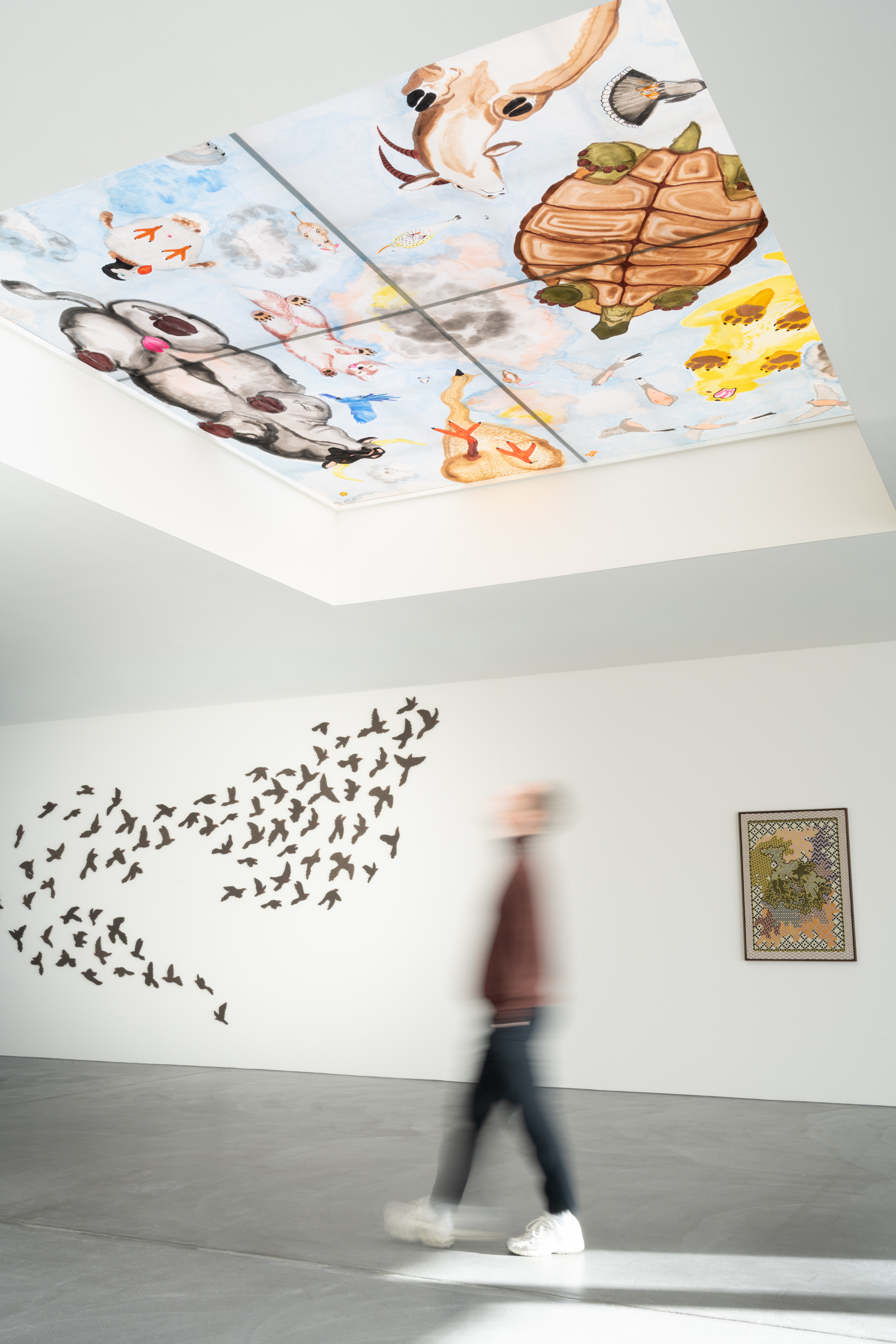
EX (Passenger Pigeon), 2025
Wall installation of ceramics with fluorescent red fly-tying eyes, 300 x 500 cm
The installation portrays a flock of passenger pigeons flying toward the gallery’s ceiling window. Once the most abundant bird species in North America, passenger pigeons formed enormous flocks that could block the sun for hours or even days as they passed. The species was since driven to extinction due to intensive hunting and deforestation. EX (extinct) is a reference to the species’ Red List classification.
Through the use of materials – clay pigeons and fluorescent red eyes used for fly fishing, representing the passenger pigeon’s characteristic carmine-red eyes – the installation references hunting and fishing. Both practices have, throughout the history of mankind, led to species becoming extinct as humans have spread across the globe, disrupting the natural ecological balance of diverse ecosystems, making humans the ultimately most invasive and destructive species.
Emilia Bergmark, exhibition view, Going, Going, Gone., view on EX (Passenger Pigeon), 2025, von Bartha, Basel, 2026. Photo: Finn Curry / von Bartha

YOLO
Dodo,
2026
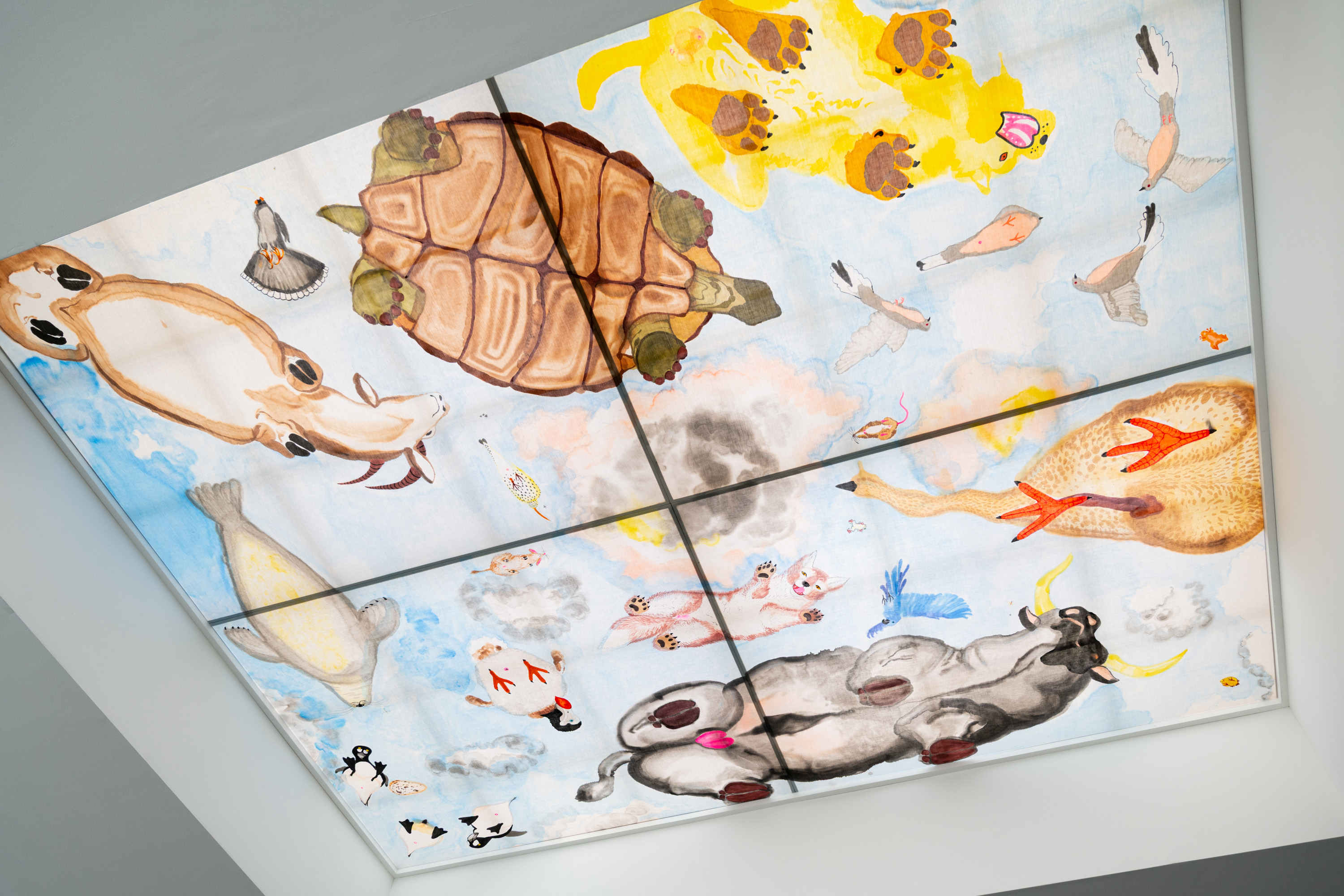
Four-panel painting on repurposed fabric, 342 x 416 cm
YOLO Dodo is a large-scale work made specifically for the ceiling window at von Bartha in Basel. Looking down at the visitors is a dodo, accompanied by five passenger pigeons, a bluebuck, a loomery of great auks, a moa bird, a swarm of Roberts Stoneflies, a huia, a southern pig-footed bandicoot, a Pecatonica River mayfly, a golden toad, a robust burrowing mayfly, a Falkland Islands wolf, a smilodon, a gastric-brooding frog, a Stephens Island wren, a slender-billed curlew, a Bramble Cay mosaic-tailed rat, a Spix's macaw, an aurochs, and a Caribbean monk seal.
All of these species were driven to extinction as a result of human activity, whether it be hunting, climate change, or diseases introduced by humans to new continents. The story of each species’ extinction resembles a saga or a modern mythology.
YOLO Dodo portrays the animals looking down on visitors. In turn, visitors are granted a glimpse of a special place in heaven where extinct animals spend their afterlife, safe from humans. Painted on repurposed hospital sheets, the choice of material forms a bond between fragile, sick, and perhaps dying humans and their extinct animal counterparts.
Emilia Bergmark, exhibition view, Going, Going, Gone., view on
YOLO Dodo, 2025, von Bartha, Basel, 2026.
Photo: Finn Curry / von Bartha
Four-panel painting on repurposed fabric, 342 x 416 cm
YOLO Dodo is a large-scale work made specifically for the ceiling window at von Bartha in Basel. Looking down at the visitors is a dodo, accompanied by five passenger pigeons, a bluebuck, a loomery of great auks, a moa bird, a swarm of Roberts Stoneflies, a huia, a southern pig-footed bandicoot, a Pecatonica River mayfly, a golden toad, a robust burrowing mayfly, a Falkland Islands wolf, a smilodon, a gastric-brooding frog, a Stephens Island wren, a slender-billed curlew, a Bramble Cay mosaic-tailed rat, a Spix's macaw, an aurochs, and a Caribbean monk seal.
All of these species were driven to extinction as a result of human activity, whether it be hunting, climate change, or diseases introduced by humans to new continents. The story of each species’ extinction resembles a saga or a modern mythology.
YOLO Dodo portrays the animals looking down on visitors. In turn, visitors are granted a glimpse of a special place in heaven where extinct animals spend their afterlife, safe from humans. Painted on repurposed hospital sheets, the choice of material forms a bond between fragile, sick, and perhaps dying humans and their extinct animal counterparts.
Emilia Bergmark, exhibition view, Going, Going, Gone., view on
YOLO Dodo, 2025, von Bartha, Basel, 2026.
Photo: Finn Curry / von Bartha
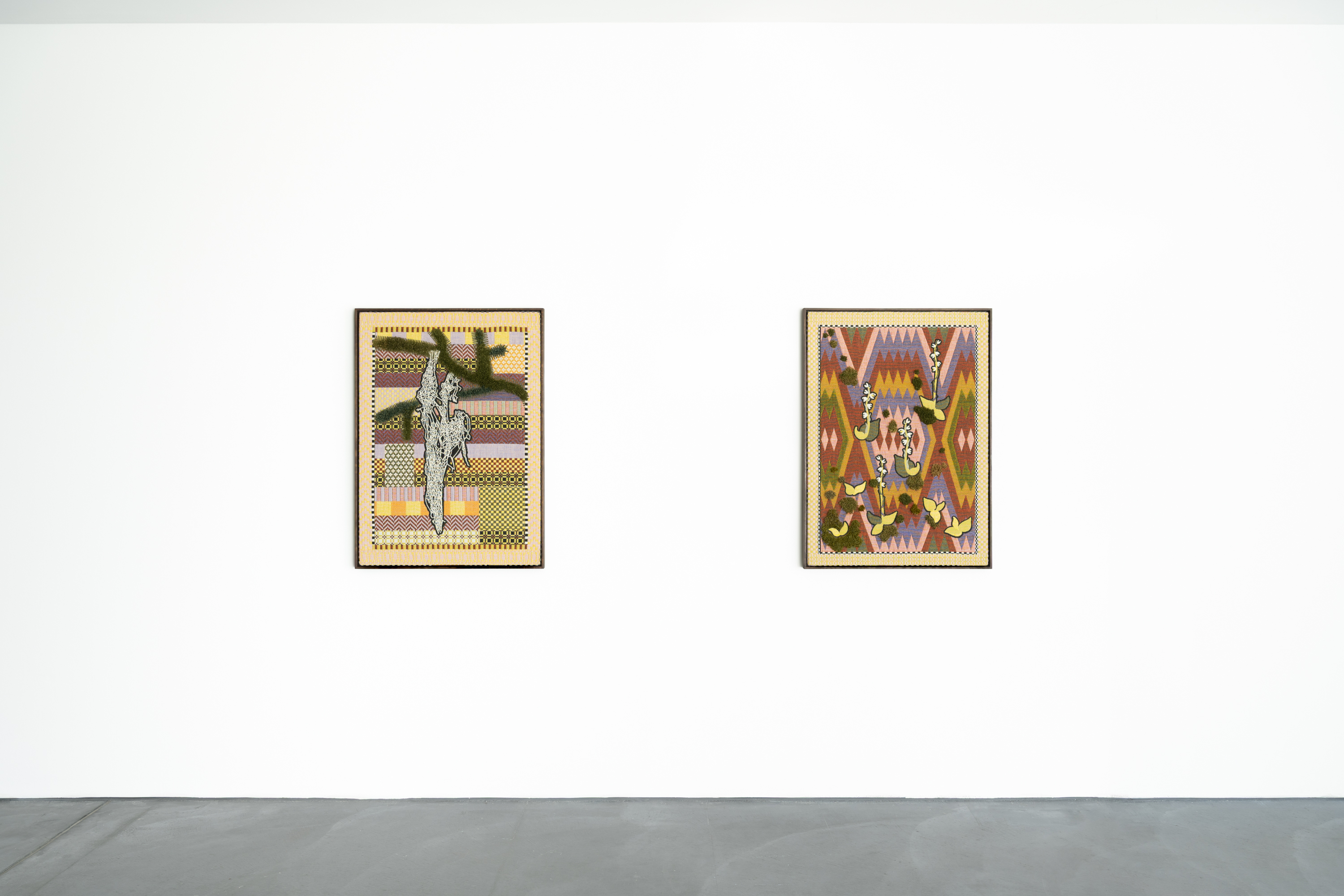
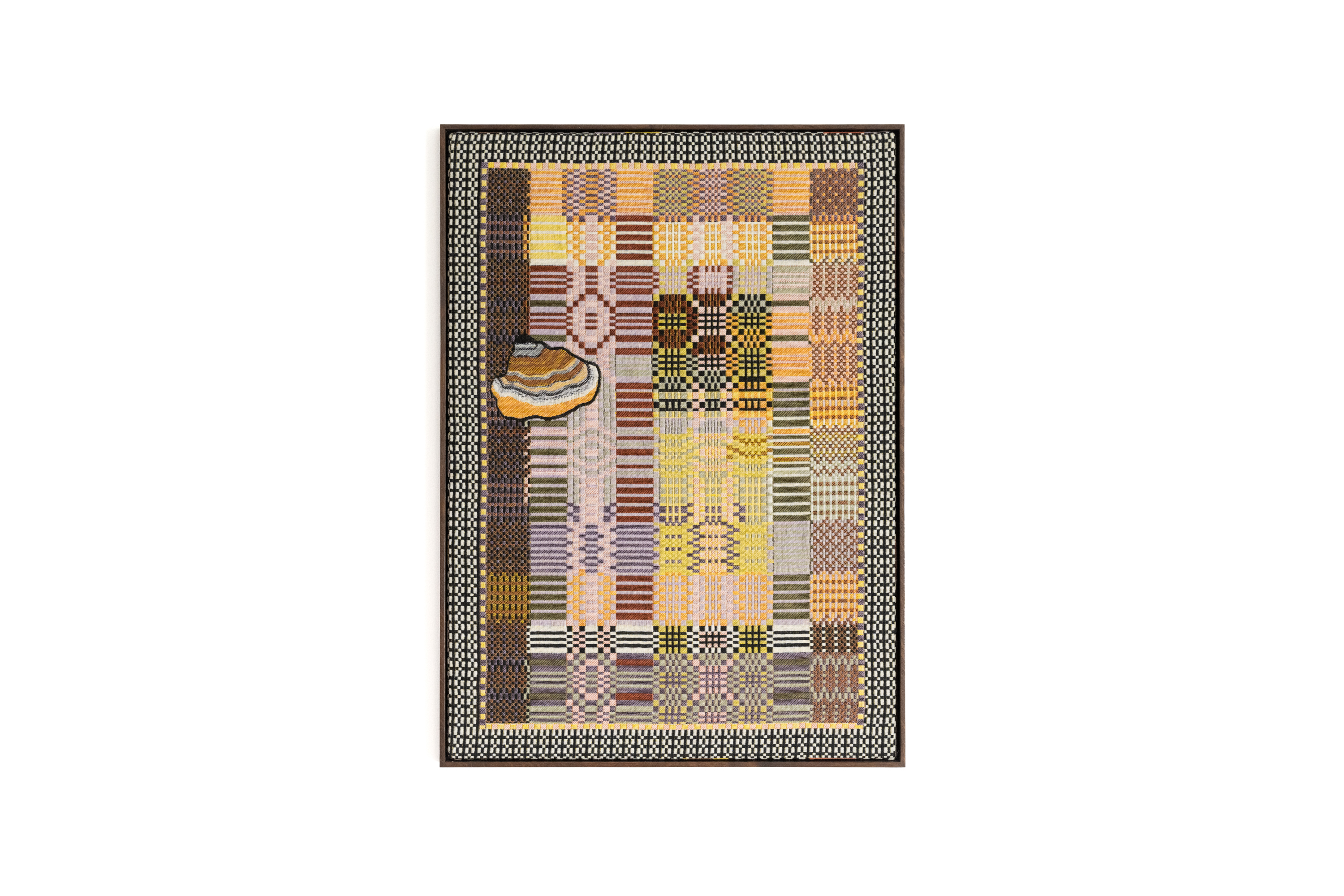
NT (Garnlav), 2025
Jacquard wool weave and embroidery, 77 x 106 cm
VU (Knärot), 2025
Jacquard wool weave and embroidery, 77 x 106 cm
NT (Lunglav), 2025
Jacquard wool weave, 77 x 106 cm
NT (Tallticka), 2025
Jacquard wool weave, 77 x 106 cm
The four textile works portray threatened species living in the Swedish forests. Such species are often difficult for the human eye to perceive; they may be small, shy, hidden in deadwood, or very rare. By remixing traditional Swedish textile techniques and local patterns, Bergmark has created vibrant portraits of each species, magnifying their size and giving them a visual presence that cannot be overlooked.
The labels NT (near threatened) and VU (vulnerable) refer to a species’ status on the so-called Red List, an international system that assesses the conservation status and extinction risk of species. In Sweden, species surveys are one of the few tools available to activists seeking to prevent the logging of biodiverse natural forests. If several threatened species are found in a forest scheduled for clear-cutting, logging permits can be paused or contested. As a result, NT- and VU-listed species, especially the small orchid knärot, are loved by activists and biologists and hated by the forest forestry industry.
Emilia Bergmark, exhibition view, Going, Going, Gone., view on
NT (Garnlav) and VU (Knärot, both 2025, von Bartha, Basel, 2026. Photo: Finn Curry / von Bartha